Posts

Augustine (Aage) of Dacia's 1260 AD summary of the Medieval Fourfold Method (Quadriga) as opposed to later formulations.

Image
I offer this as a corrective.  The earliest known text to include the Quadriga is thought to be Augustine (Aage) of Dacia's  Rotulus Pugillaris (1260), as follows: Littera gesta docet, quid credas allegoria. (The Letter teaches acts [what was literally done], the Allegory what you should believe) Moralis quid agas, quid speres anagogia. (The moral [teaches] what you should do, the Anagogy, what you should hope for) I offer clips of the original to aid in the accurate representation of both Augustine's and Nicholas of Lyra's versions. Very often sources misrepresent the former author by presenting a form with a different final statement, so that instead of Augustine's " quid speres anagogia ," (Anagogy, what you should hope for), he is credited instead with quo tendas anagogia , (The Anagogy, where you should be bound) a form used, for example, by Nicholas of Lyra (see below). Examples of the error can be found, to mention only few examples, i...

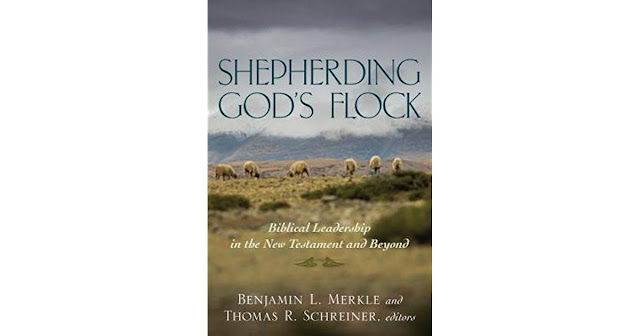
A FEW MORE WORDS ON JASON G. DUESING'S ARTICLE AND SOME REFLECTIONS ON THE BAPTIST FAITH AND MESSAGE AND THE VOCABULARY OF NEW TESTAMENT CHURCH GOVERNMENT

Image
I mentioned in my previous post that I was reading Jason G. Duesing’s contribution to the book, Shepherding God's Flock: Biblical Leadership in the New Testament and Beyond (ed. Benjamin L. Merkle and Thomas Schreiner; Grand Rapids, MI: Kregel, 2014). It is entitled “A Cousin of Catholicism: The Anglican Understanding of Church Leadership.” As often happens when I am reading something that's said sends me off in another direction. I had mentioned that the New Testament had a two-tier model of leadership elder/bishops and deacons. I questioned Duesing a little on the statement on the persistence of the New Testament model in this Church in the centuries following. But in fairness I should say that he was not writing so much as a scholar himself but as a popular writer reporting what different scholars had said in standard reference works and popular books. This being the case, the statement about the terms "bishop" and "elder" being used intercha...

A couple of corrections/clarifications to Jason G. Duesing's "A Cousin of Catholicism: The Anglican Understanding of Church Leadership."

Image
I am reading Jason G. Duesing’s interesting contribution to the book,  Shepherding God's Flock: Biblical Leadership in the New Testament and Beyond  (ed. Benjamin L. Merkle and Thomas Schreiner; Grand Rapids, MI: Kregel, 2014). It is entitled “A Cousin of Catholicism: The Anglican Understanding of Church Leadership.” Deusing is exploring the issue of the dependence of Anglican Ecclesiology on Roman Catholicism. I think I’m going to agree with his overall thesis, but so far I have run up against a couple of things calling for clarification. The author seems to overestimate both the power and influence of the Roman Church in its ability to control things and shape institutions in early centuries of Christianity. We see this, for example, in his statement: By the late sixth century, the churches throughout the Mediterranean region followed the increasing consensus that the bishop of Rome held greater authority over all other bishops. The bishop of Rome served in successi...

Why the argument for 70 AD as for the terminus a quo for the writing of the Gospel of Mark isn't sustainable

Image
Many scholars date Mark as the earliest Gospel after 70 AD because in it Jesus predicts the destruction of the Temple, which took place at that date. They then date the other Gospels later accordingly,usually arbitrarily placing them ten years apart. The underlying argument is, of course, a naturalistic one, namely that since no one can really predict the future, Jesus couldn't have done so either, and therefore Mark or somebody must have made that up later and placed it on Jesus' lips. This is illustrative of the  larger fact that in many cases our acceptance or rejection of Christianity's supernatural claims precedes rather than follows from our scholarly work. We judge what we believe could have happened on the basis of our our own experience or lack of experience of the spiritual realities the Bible describes. In this case however there are a number of problems that go beyond that basic nature/supernatural divide: (1) Even granting a naturalistic poin...

"A man's life does not consist in the abundance of his possessions" (Luke 12:15)

Image
The Gospel of Luke's special emphasis on wealth and poverty is shown in both the material he has exclusively and the way he presents material he shares with the other Gospels. It is only in Luke, for example, that we find the famous parable of Lazarus and the Rich (Lk 16:19-31). Similarly, where in Matthew's version of the Sermon on the Mount the first beatitude begins, "Blessed are the poor in Spirit...," (Mt 5:3), Luke has simply "Blessed are you poor" (Lk 6:20). Luke also includes, as Matthew does not, a series of Woes to the rich immediately following his version of the Beatitudes (Lk 6:25-26). I mention the above as a preface to another passage found only in Luke, where Jesus, in response to someone who wants him to intervene in an inheritance dispute: Someone in the crowd said to him, “Teacher, tell my brother to divide the inheritance with me.” Jesus replied, “Man, who appointed me a judge or an arbiter between you?” Then he said to them, “W...

JESUS NOT ONLY DIDN'T EXIST, HE WAS ALSO A LYING BASTARD! THE SECOND-CENTURY WRITER CELSUS AS SEEN THROUGH THE EYES OF ROBERT M. PRICE

Image
When looking at the arguments of Robert M. Price, I am often left feeling that he is rubbing the evidential fur (not to mention mine) the wrong way. In a debate with Bart Ehrman, Robert M. Price begins his opening salvo (36 minutes) by attempting to refute the following statement from page 96 of Bart Ehman’s 2012 book, Did Jesus Exist : “The idea that Jesus did not exist is a modern notion. It has no ancient precedents.” Price's quotations included one from the second-century, anti-Christian philosopher Celsus that he puts forward as denying Jesus existence: “It is clear to me that the writings of the Christians are a lie, and that your fables have not been well enough constructed to conceal this monstrous fiction.”* But Price's quotation doesn't do justice to Celsus' position.  If it did, we would need to argue that Celsus not only denied that Jesus existed, but also that he held that this non-existent Jesus, as it were, added insult to injury by lying ...

ENGLISH WORKS OF ROBERT M. PRICE'S INSPIRATION, W. C. VAN MANEM

Image
Willem Christiaan Van Manen W. C. van Manen, "A Wave of Hyper Criticism," Expository Times 9.5 (Feb 1898): 205-211 ;   9.6 (Mar 1898): 257-259 ; 9.7 (Apr 1898): 314-319 . W. C. van Manen Encyclopedia Biblica Articles " Paul ,"columns 3:3603-3638 (sec. 1-3, 33-51) " Old-Christian Literature ," 3:3471-3495. " Rome (Church) ," 4:4145-4157. " Epistle to the Romans ," 4:4127-4145 " Philippi ," 3:3701-3703. " Epistle to the Philippians I (Paul's) ," 3:3703-3710. " Epistle to the Philippians II (Polycarp's) ," 3:3711-3713. (Not Polycarp). " Epistle to Philemon " 3:3693-3697. " Shepherd of Hermas ," 4:4456-4458. Another source Price is enamored with is: David Trobisch, " Who Published the New Testament ," Free Inquiry 28.1 (Dec 2007-Jan 2008): 30-33. "I will conclude these considerations with a bold statement: The New Testament was publis...